Elbow Pain
Elbow pain has a way of interrupting almost everything.
Gripping a coffee cup, opening a door, typing, lifting, turning a key. The elbow is involved in so many everyday movements that when something is not right, it becomes difficult to ignore.
Most people associate elbow pain with sport. But we regularly see it in people who have never picked up a tennis racquet or golf club. Desk workers, tradespeople, parents carrying young children, people who have simply increased their activity level. The elbow is vulnerable to repetitive load from many different sources.
At Northbridge Chiropractic, we look at what is driving your elbow pain and work with you on a care plan that is specific to your situation.

What Can Contribute to Elbow Pain
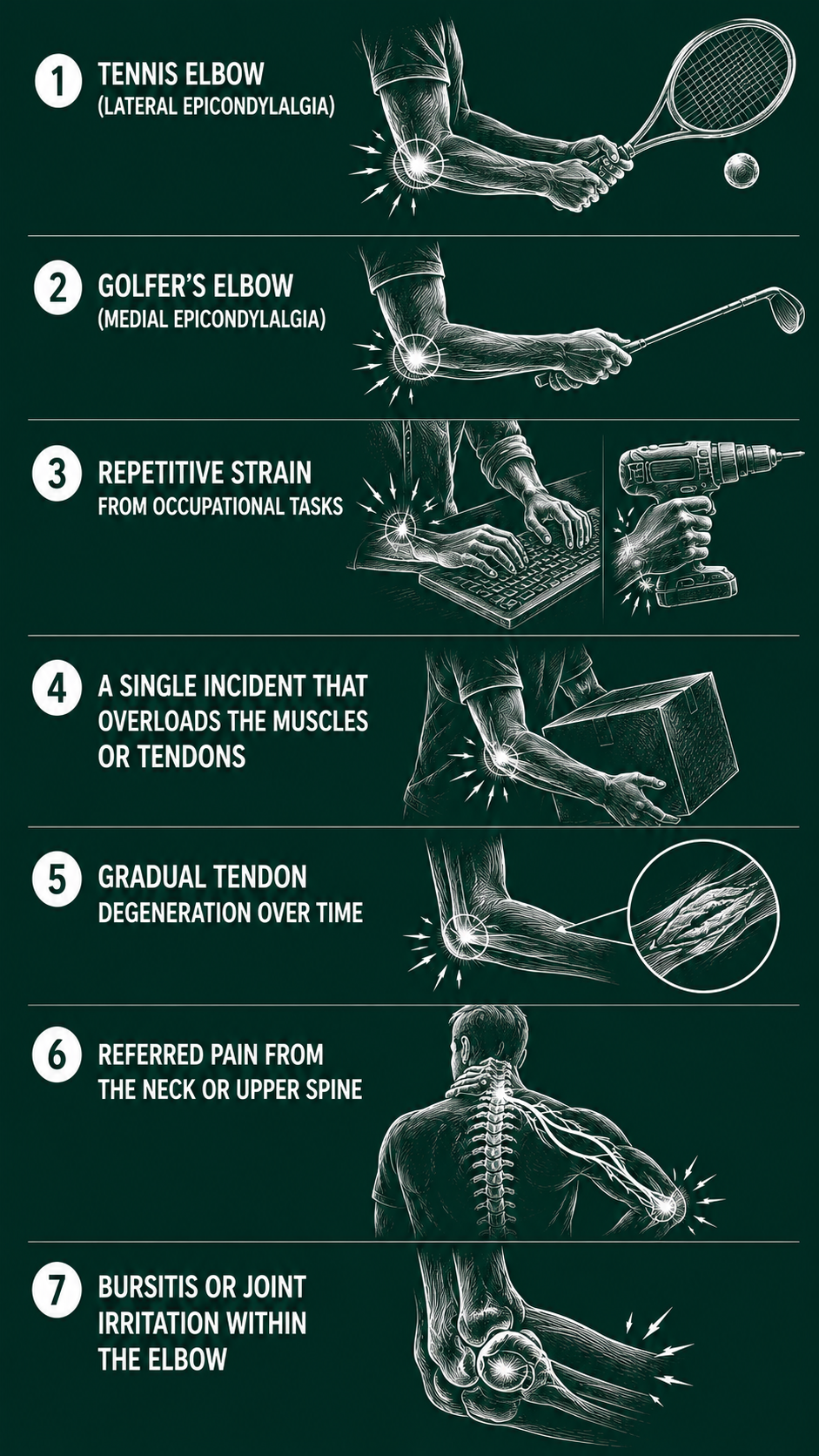
Elbow pain can develop from a number of different sources. Some of the most common things we see include:
➜ Tennis elbow, or lateral epicondylalgia, which involves the muscles and tendons on the outer side of the elbow. It is commonly associated with repetitive wrist extension movements but can affect anyone who loads the forearm repeatedly, not just tennis players.
➜ Golfer’s elbow, or medial epicondylalgia, which affects the inner elbow and is associated with repetitive gripping or wrist flexion movements. It is frequently seen in tradespeople and office workers as well as golfers.
➜ Repetitive strain from occupational tasks such as typing, tool use, or any work involving sustained forearm muscle activity.
➜ A single incident that overloads the muscles or tendons of the forearm, such as an awkward lift or sudden exertion.
➜ Gradual tendon degeneration over time, particularly in people who have had recurring elbow discomfort that was not fully addressed.
➜ Referred pain from the neck or upper spine, where nerve irritation travels down the arm and is felt at the elbow.
➜ Bursitis or joint irritation within the elbow itself.
Tennis Elbow and Golfer’s Elbow Explained
These are two of the most frequently seen elbow conditions and they are often misunderstood.
Tennis elbow involves the tendons on the outer elbow that attach the forearm extensor muscles to the bone. Repeated tension through these tendons, whether from sport, work, or daily tasks, can cause micro-damage that leads to localised pain, particularly when gripping, extending the wrist, or lifting.
Golfer’s elbow is a similar process but affects the inner elbow where the forearm flexor tendons attach. Pain is typically felt on the inside of the elbow and can radiate down toward the wrist.
Both conditions can develop gradually over time and are often made worse by continuing to load the affected area without addressing the underlying pattern. If not properly managed, both can become persistent and harder to resolve.
We often see people who have been managing one of these conditions for months before coming in. Early assessment and a structured approach can make a meaningful difference to recovery.
Two Things You Can Try in the Meantime
These are general suggestions that many people find helpful while managing elbow discomfort. They are not a substitute for a proper assessment, but they are a practical starting point.
How We Approach Elbow Pain at Northbridge Chiropractic
We start with a thorough assessment before anything else.
We look at the elbow and at the structures above it, including the shoulder, neck, and upper spine, because referred nerve irritation from the cervical spine can contribute to elbow symptoms in ways that are not always obvious. We ask about how the pain started, what activities make it worse, and what you have already tried.
Depending on what we find, your care may include active release therapy, which uses a combination of precise tension and movement to address soft tissue restrictions and scar tissue build-up, trigger point therapy to release areas of muscle tension contributing to pain and reduced function, Graston therapy, an instrument-assisted soft tissue technique that works through the layers of tissue around the elbow and forearm, dry needling to address trigger points in the forearm, upper arm, and surrounding musculature, myofascial cupping to support tissue mobility and circulation in the affected area, and chiropractic assessment of the cervical spine and shoulder where nerve referral may be contributing.
We also discuss load management. Understanding which activities are aggravating the elbow and how to modify them temporarily is often an important part of the recovery process.
What Happens at Your Appointment
If this is your first visit to Northbridge Chiropractic, here is what to expect.
Your first appointment is longer than a standard visit. We take time to understand your history, how the elbow pain started, and what you have already tried. We ask about your occupation, your activity levels, and any previous injuries to the elbow, shoulder, or neck.
We then carry out a physical assessment of the elbow and surrounding structures, including the shoulder and cervical spine where relevant.
We will walk you through what we find and explain what may be contributing to your discomfort. If we feel chiropractic care may be appropriate for your situation, we will outline what a care plan could look like and give you a realistic sense of what to expect over time.
There is no pressure. You are welcome to ask as many questions as you like before making any decisions.
Follow-up appointments are more focused. As we get to know how your body responds, we adjust the approach accordingly.
Would you like to understand what may be contributing to your elbow pain?
If elbow discomfort has been affecting your work, your sport, or your daily activities, we would be happy to help.
Book online to secure your appointment with Dr Mario Vinci or Dr Nicola Colebrook at Northbridge Chiropractic, Perth. Or call us on (08) 9227 9341.
We accept all major health fund cards.
Get in
touch
6/177 Stirling Street Perth WA 6000
OPENING HOURS
Practitioners
- Dr Mario:
- Monday 2:00 pm – 7:00 pm
- Tuesday & Thursday 8:30 am – 7:00 pm
- Friday 8:30 am – 12:30 pm
- Saturday 8:00 am – 12:00 pm
- Dr Clay:
- Monday 8:30 am – 6:30 pm
- Wednesday 8:30 pm – 6:30 pm
- Dr Nicola (on maternity leave)
- Sydney (R.Massage Therapist)
- Monday 7:00 am- 12:00 pm
- Thursday 7:00 am- 12:00 pm
Admin Support
- Emmy:
- Monday & Wednesday 12:30 pm – 7:00 pm
- Tuesday & Thursday 8:30 am – 7:00 pm
- Friday 8:30 am – 12:30 pm
- Maya:
- Saturday 8:00am-12:00pm