What Is Spinal Degeneration and Should I Be Worried?

Lower back pain does not have to be something you simply accept as part of getting older. We often see it build up gradually over years, shaped by posture, movement habits, and the way the body adapts to daily load over time. Understanding what may be contributing is always more useful than pushing through it alone. Book online if you would like support
Spinal degeneration sounds alarming. The word itself doesn’t help. But it’s one of those terms that causes far more anxiety than it usually warrants.
Here’s what it actually means.
Spinal degeneration is an umbrella term for age-related changes in the spine. These include changes to the discs, the vertebrae, and the joints. Things like disc narrowing, bone spurs, and facet joint changes all fall under this category.
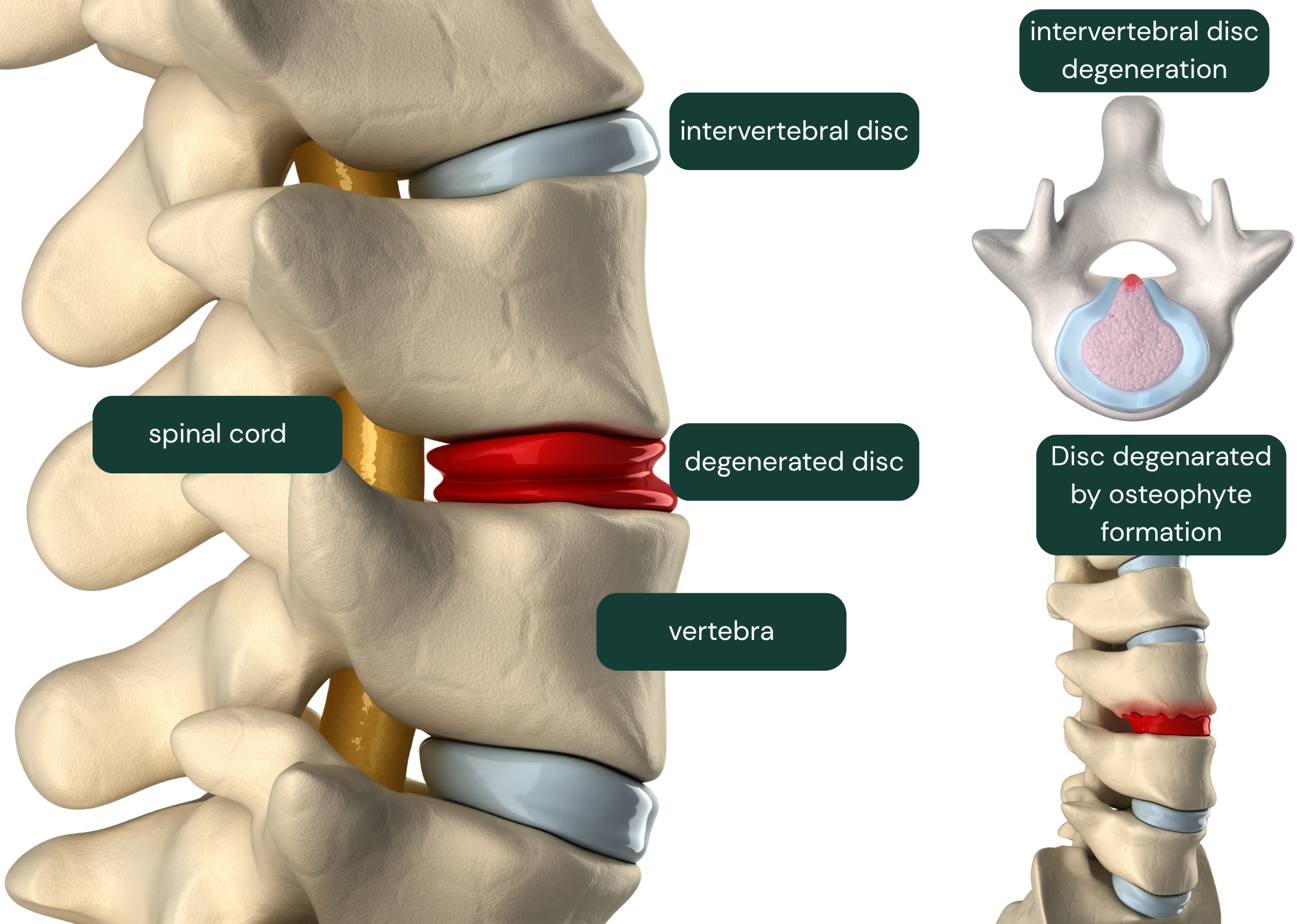
Most people don’t realise that spinal disc degeneration is not always the result of a single injury. It often develops gradually over time, shaped by how the spine moves and loads day after day. The two insets here show what that process can look like from different angles, including the bone spur formation that can sometimes accompany disc changes. Understanding what is happening in the spine is where informed care begins.
The important thing to understand is that these changes are extremely common. Studies consistently show that a large proportion of people with no pain at all show signs of spinal degeneration on imaging. It increases with age, but it’s a normal part of how the spine changes over time, not necessarily a sign that something is seriously wrong.
The relationship between what shows up on a scan and how someone feels is not straightforward. Two people can have identical findings on imaging and have completely different experiences. One may have significant discomfort. The other may have none.
This is why imaging alone is rarely the whole story.
What matters more in practice is how your spine is moving, how you’re loading it, and how your body is functioning overall. Degeneration doesn’t mean your spine is broken. It means it has adapted and changed over time. How it’s supported from here is what tends to make the most difference going forward.
Things that may support spinal health over time include consistent movement, maintaining muscle strength around the spine, avoiding sustained static postures for long periods, and regular chiropractic care to support how the spine is moving and loading.
If you’ve received a scan result that has left you with more questions than answers, bring it in. We’re happy to walk through what it means for you specifically.
👉 Book online if you’d like support
— Dr Mario, Northbridge Chiropractic
Feeling tight, sore or just not quite right?
Get simple, practical tips on posture, stress, and recovery…So your body can move and feel better day to day.
No spam. Just helpful emails you can actually use.